Showing posts with label Education. Show all posts

Tuesday, 29 March 2016


by Manisha Mahadeva, Junior 1 Cempaka, Class of 2017
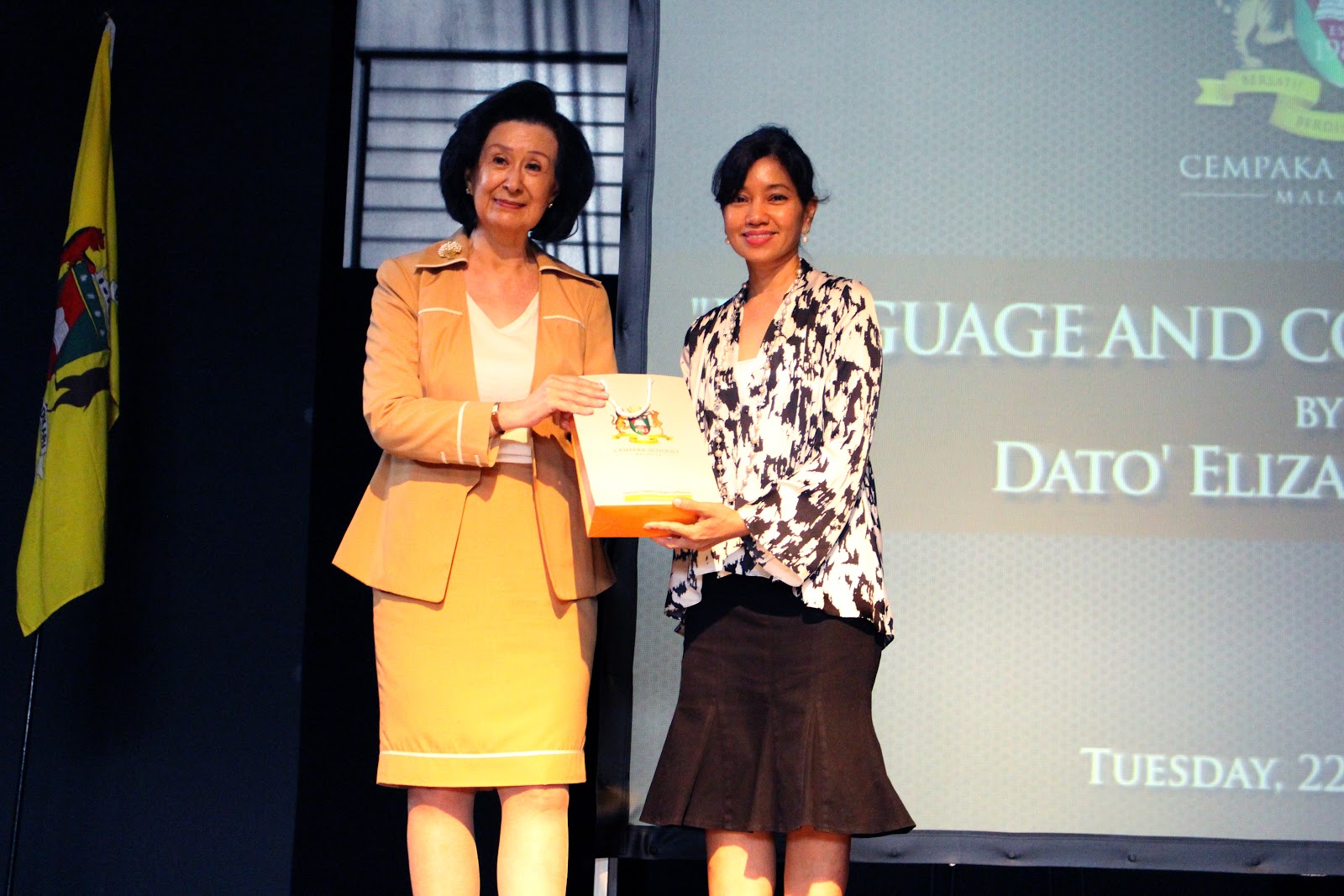
On the 22nd of March, Cempaka Damansara Heights was extremely honoured to have yet another esteemed guest give a special talk during an assembly-Dato Elizabeth Soo. Dato Elizabeth has made a name for herself in the hospitality arena, with more than 26 years of experience as the Public Relations and Marketing Communication Director for various well known hotels such as the Kuala Lumpur Hilton, Pan-Pacific group in Malaysia and the Legend Hotel chain.

During the special assembly, Dato Elizabeth gave a memorable and interesting speech, titled “Language and Communication”. During this speech, she talked about the many ways of communication, including the importance of it and why we do so. In her talk, Dato Elizabeth had touched on the ‘3 vs’ which most people are judged on, when they communicate: verbal, vocal and visual. In explaining this system to us, she taught us how to use these methods to converse with others using her own experience as reference.
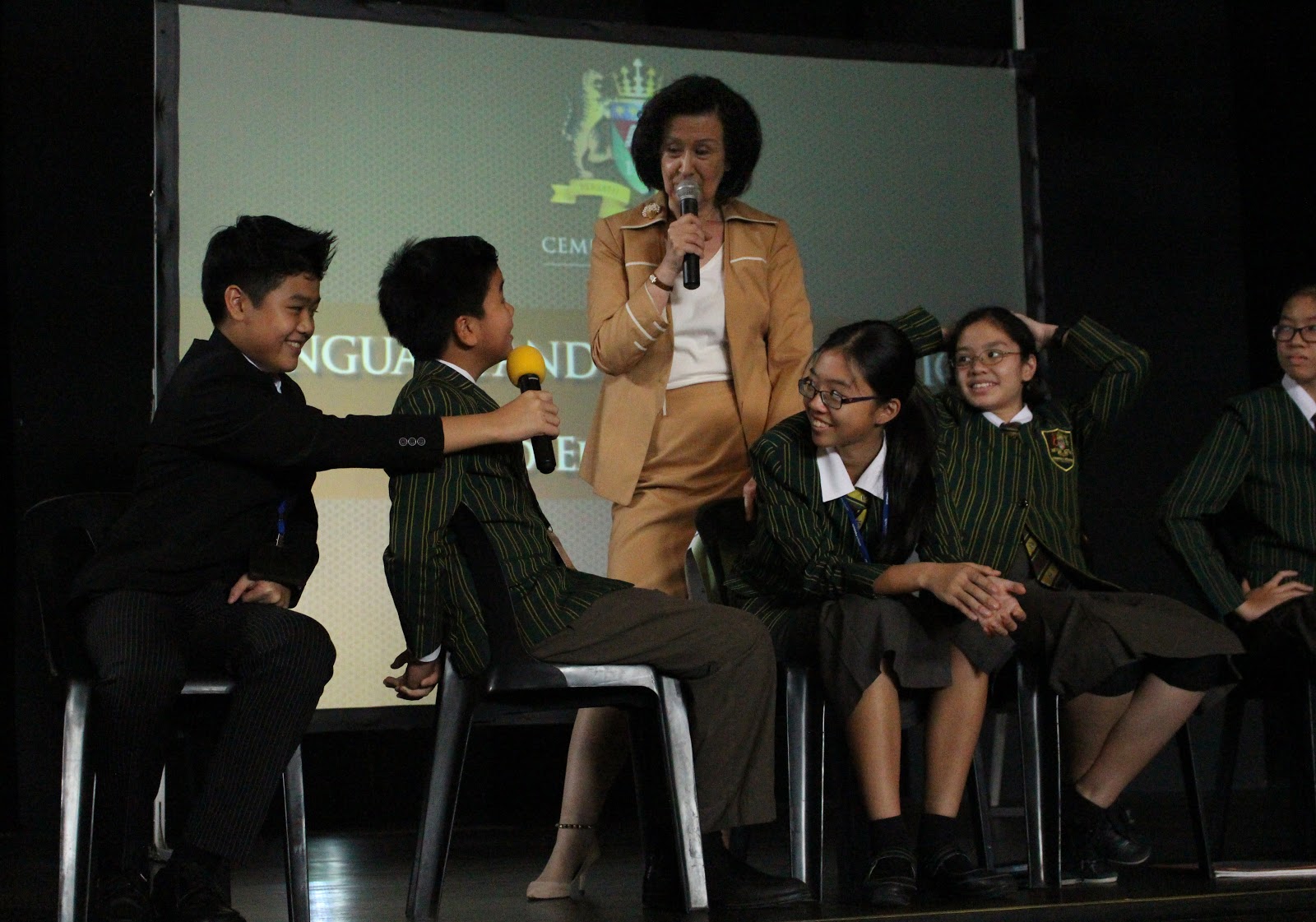
Over the course of an hour or so, Dato Elizabeth spoke about communication and demonstrated it using the help of a few students as actors. This was definitely a unique way of conveying the message of her talk as she managed to grasp everyone’s attention and kept her audience interested.
What I liked most about this enlightening talk was that, despite Dato Elizabeth’s topic being a very broad one, she managed to relate it to what we, as students, face in our everyday challenges. All in all, I believe that this was definitely a meaningful talk which was worth our time . We are grateful and thank Dato’ Elizabeth for gracing us with her presence and sharing her knowledge with us on Language and Communication.
by Nicholas Tan 15:31 929 comments | in , ,
Read More

Tuesday, 30 June 2015

by Julian Yang, Year 6, Class of 2020.


Every year, we have a competition for Mathematics called “Maths Olympiad”. Previously, the competition had three levels each, for Year 1 and 2, Year 3 and 4, and Year 5 and 6. There also used to be three rounds, everyone did the first, selected students partook in the second, and only one from each level, for each house, competed in the third. This year, the competition was changed entirely, instead of basically just sitting down and taking a test, there was a treasure hunt. There were eight teams in total, two for each of the four houses, all with their own group leaders and group names.

The day before Maths Olympiad, the Upper Primary students were gathered to be briefed and assigned into their groups. The group leader and group name for each group was chosen by the members of the respective group. On the day that Maths Olympiad was to be held, the students gathered again in front of the swimming pool before they set off for the challenge. When it started, each group was given a different puzzle to solve, the answer to the puzzle was the name of the next place they had to go to.

There were several challenges that were presented to the challengers. A list of those challenges would include: making the most number of triangles with sticks, moving a stack of leaves with certain rules, arranging chess pieces in a certain way, drawing angles by laying down, measuring the volume, area, and perimeter of the swimming pool, a maths relay, and some other maths challenges.

When all the groups had finished all of the challenges, they gathered yet again at where they started to announce the champions. After proclaiming the points that each group had received, the announcer said, “The winner is… group Bob!” Everyone laughed or at least giggled at the rather funny name of the Beruang group amongst the other, more serious ones like, “Mathologists” and “Eye of the Tiger”. In the end, everyone had lots of fun with the new and teamwork based version of Maths Olympiad. We all look forward to the next Maths Olympiad in 2016!

Friday, 26 June 2015

by Emma Lim, Junior 2 Higgs, Class of 2015.
All photographs by Lai Li Chan, Junior 2 Higgs, Class of 2015. 

Waking up early for the education you so rightfully deserve from Monday to Saturday, with no ounce of dread just to attend classes for a mere 4 hours, walking or cycling your way to every destination you wish to reach even if it means a pair of swollen feet. Working to your full capacity every day to earn enough money for your four siblings to get the already insufficient nutrition they desperately need. This is not my life; neither is it yours. However, it is the lives of many underprivileged children living in Cambodia. 

Nevertheless, their monetary status does not affect these children's views in life. The life in their eyes has yet to fade and their smiles have not been wiped off their faces despite the unfortunate circumstances they live in. No bitterness was found in their hearts as they wholeheartedly embraced us, the Interactors, as we fully prepared ourselves to be immersed in the culture they had to offer. 


For most of the Cambodian population, the country’s official religion - Theravada Buddhism, is the faith of choice. Theravada Buddhism has been their state religion since the 13th century, with the exception of the Khmer Rouge period. The minority religions include Islam, Christianity and tribal animism. Previously, Islam was practiced by about 200,000 Cambodians but their numbers dwindled due to the persecutions under the Khmer Rouge.

The orphanages we went to gave us glimpses of Cambodian dances. The girls performed intricate and slow hand gestures which were complimented by simple and light footwork, alongside a slow traditional song in their native language, Khmer. Dressed in the Cambodian national dress, the "Sampot", with an armful of chunky, colourful bangles, their gentle and fluid movements were executed to the best of their capabilities.


Though every meal we ate was provided by Muslim restaurants, unknowingly, we were eating Cambodia’s staple foods. As Cambodia is one of our Southeast Asian neighbours, their eating habits are very similar to ours. Most meals were accompanied by rice, with dishes containing fish sauce, which is widely used in the country, evident by the countless tom yam soups that our troop were served during lunch and dinner. Unfortunately, we weren’t able to savour the popular dishes Cambodia was known for, namely their pork broth rice noodle soup and curry, which are highly influenced by the Chinese and Indian cultures respectively.


The abundance of culture in Cambodia is meant to be indulged personally, not to be read as a mere article which doesn’t do it much justice. The world Cambodia has created is unlike any place you have been to before. Dare to throw yourselves into a journey of excitement and adventure? You will not regret it.


Search